Who is the “Golden Devi”?

Who is the “Golden Devi” ?
First in The Series - Reflections on Tibetan Buddhist Meditation
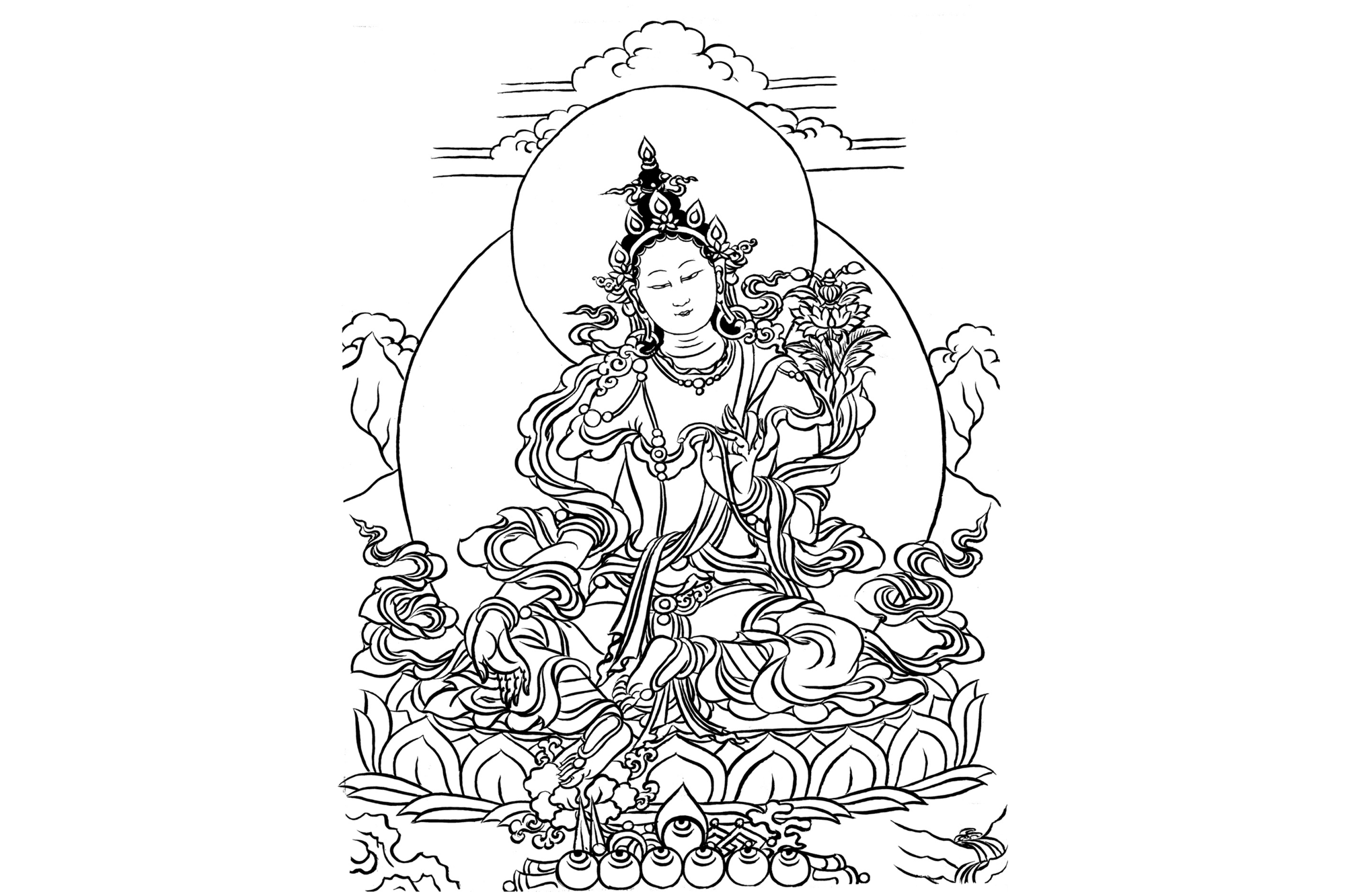
The Golden Devi pictured in my logo is actually the fourth Tara in the Tibetan pantheon of the Twenty-One Taras. As you may know, Tara is among the most revered of Tibetan Buddhist deities, especially in the form of “Green Tara”. Tara, (“Drolma” in Tibetan) is first and foremost a savioress and protector. She is said to be “swift” in that she quickly comes to the aid of those that call on her. She is limitlessly compassionate; she does not discriminate among those deserving or seemingly undeserving of her help.
This beloved goddess and female Buddha manifests in twenty one forms, some peaceful, some fierce each expressing different qualities and aspects of Tara’s “enlightened activities”. A seminal text (tantra), Praises to The Twenty Taras is said to have been taught by the Buddha. The underlying intention of such a teaching is to reveal aspects of Tara that we can call upon through the joys and hardships of our human lives. One of my revered teachers, Dorje Lopon Chandra Easton recently published a beautiful book, Embodying Tara, that comments on these verses and provides a sadhana practice for each one (More about sadhana practice and deity yoga to follow). Lopon Chandra also provides an example of a modern day Tara for each of the twenty one Taras, illustrating that the energy of the enlightened feminine is alive and working in our world.
My “Golden Devi”, the fourth Tara, is Drolma Tsugtor Namgyalma (Tibetan), Usnisa Vijaya (Sanskrit). Her name means “victorious queen of crowning light”. As is the case for some of the Taras, she exists as a revered Hindu goddess as well in the form of “Usnisa Vijaya”. Visualization is an important part of Tantric practice so each of the Tara’s is described in some detail. I will use parts of the description of appearance and activities from Lopon Chandra’s practice text for this Tara:
“…she is seated on a full moon disc atop a lotus flower, surrounded by numerous wisdom beings. She is peaceful and golden yellow in color…Her left hand is in the mudra (hand position) of the Three Jewels at her heart and holds the stem of a blue lotus, the Utpala flower which rests above her left shoulder. Upon the lotus is a vase of immortality, overflowing with healing nectar. Her right hand is placed on her right knee and faces upward, palm open in the gesture of Supreme Generosity.”
The practice texts then go on to describe each Tara’s particular enlightened activities. In the case of Drolma Tsugtor Namgyalma:
“Swift and compassionate (she) bestows longevity…she gives protection from unvirtuous activities and disturbing emotions. The healing nectar from her vase balances the energies of the five elements and revitalizes our life force.”
By this description, we can gather that this Tara is one of the “long life” deities which are most often white in color. The value of a long life (this precious human birth) in Buddhism is to extend the opportunity to grow in wisdom (eradicate past karma) and increase merit by virtuous deeds (compassionate action).
I will make a few brief comments on tantric sadhana practice and deity yoga (more to come on this in future blogs in this series). The word “sadhana” in Sanskrit means daily practice or daily discipline. A “sadhana” is a basic structured daily practice found in the Hindu, Buddhist and Jain traditions. In the case of Tibetan Buddhism, there is a typical structure that includes: chanting or reading of texts, visualization, chanting mantra and some period of “nature of mind” or “pure awareness” practice. Sadhanas can be long and elaborate or relatively short and simple.
Deity yoga is the core theme of most sadhanas. Working with a deity (Yidam) is not to be mistaken as worship of the deity or fantasizing about the deity. An open and devoted heart/mind (Città) is encouraged to enable us to visualize and feel ourselves as the deity. We look to identify with their awareness and enlightened qualities. Paraphrasing Lama Tsultrim, my main teacher, “Deity Yoga practice is the ultimate self esteem practice”. Through these practices we can come to realize that we already have these enlightened qualities. It is a matter of lifting veils of our habitual mental patterns to contact them.
Conclusion
I am very much looking forward to introducing and practicing sadhanas with new and more experienced students. The power of practice in a group is many fold that of solo practice. It also helps us to gain confidence when wading into a new practice. I encourage students brand new to meditation to take the basic sitting practice (Shamatha) course before the Introduction to Sadhana course. I will be offering the first in person versions of the Sadhana course in fall 2024.


Please sign up for our newsletter to keep up with Golden Devi. We promise that we will not overrun your inbox and we never sell your information.