The word mantra is a Sanskrit word derived from two Sanskrit roots – “manas” (mind) and “tra” (tool). Some teachers use “mind protection” as a translation, inferring that the use of mantra “protects” us from the habitual patterns and distractions of the mind. Traditional mantras originated in Hinduism and Buddhism. (We are not discussing here the modern adoption of the word to describe any motivational phrase that might be used for encouragement or positive focus)
What is Mantra?
In the Hindu and Buddhist traditions, a mantra is a sacred syllable, word or phrase that is considered to possess a particular spiritual energy that is accessed when it is recited or sung. The understanding that sound transmits energy is not foreign to many traditions. In fact in some ancient cultures sound was understood to actually manifest reality. “In the beginning was the Word and the Word was with God…” In the Hindu Yogic tradition, the “Devi of Speech” is invoked to help the yogi purify his/her use of language (lest the yogi manifest an undesirable reality through careless speech). The myriad uses of sound waves in our culture demonstrate the modern understanding of the power of sound to create and transform.
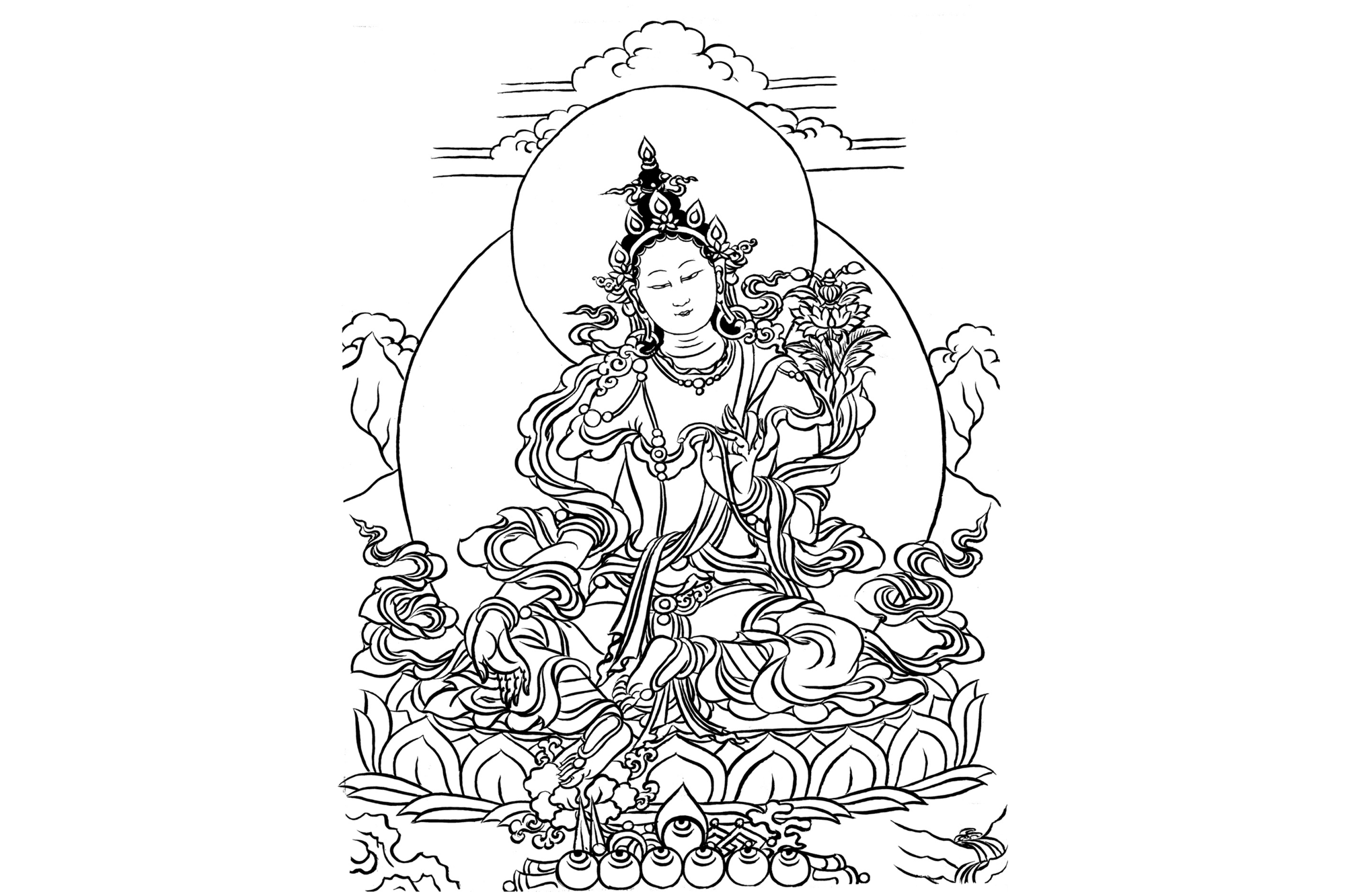
In this discussion we will focus on the use of mantra in the Tibetan Buddhist Tantric or Vajrayana* tradition. In this context mantras are always written, recited and sung in Sanskrit. Sanskrit is the sacred spiritual language of Hinduism and Buddhism and is believed to hold a special elevated vibration. A mantra can be a seed syllable, a single powerful sound that is used by itelf or in conjunction with a longer mantra or text. Common seed syllable examples are: “Om”, “Ah” and “Hum/Hung”. Deities such as Tara have a seed syllable (in her case “Tam”) associated with them to invoke their energy and presence. Mantras are most commonly a phrase associated with a deity that can be several words long like the famous “Om Mani Padme Hum” (hail or praise to the jewel in the lotus). The “jewel in the lotus” is usually understood to refer to the Buddha but can also be said to refer to one’s own enlightened being. A mantra regularly practiced in Vajrayana and found in many sadhanas is the hundred syllable Vajrasattva mantra. This mantra is said to be both purifying and protective. Most Tantric practitioners memorize the Vajrasattva mantra during the preliminary stages of their training.
Mantra recitation can be a practice on its own, referred to as “Japa”. In the Hindu Yogic tradition, mantras are often chanted with the accompaniment of a harmonium for long periods of time (or in a group setting (Kirtan) a number of instruments). Alternatively, as is common in Tibetan Buddhist practice, the recitation or singing of the mantra forms a key part of the practice of a sadhana**. In this case at least one of the mantras is specific to aspects of the deity or “Yidam” that is being supplicated. For example, the Vajrasattva mantra and may be recited/chanted in the preliminary part of the practice. Then during the visualization portion of the practice, the mantra specific to the deity will be chanted and then recited mentally.
If you are interested in mantra practice…
If a student is interested in traditional mantra practice, it is advisable to contact an experienced teacher to receive preliminary training in the practice. While it is not necessary to receive a formal initiation in most cases, there is a tradition of “transmission” of the lineage and energy of the mantra from teacher to student. In my own case, I received initiation from my first teacher, Swami Sivananda Radha, in the Green Tara mantra. I was 19 years old and have used the mantra to support and guide me through numbers of difficult times in my life. I practice other mantras in Sadhana Practice etc. but Tara’s mantra is my “go to” for focusing my mind and emotions in challenging circumstances.
At Golden Devi, training in mantra practice is included in 2 of the meditation classes offered: Bodhicitta (Compassion) Meditation and Introduction to Sadhana Practice. Individual instruction in mantra practice and any of the types of meditation training are available as a private class series upon request. Please watch for fall class schedules that will be published by early August
*Tantra and Vajrayana are used interchangeably
**Please refer to the previous article in this series for more description of Tibetan Sadhanas